
martin luther 95 theses summary pdf
Martin Luther’s 1517 document‚ initially an academic challenge‚ questioned the sale of indulgences and sparked debate‚ ultimately reshaping Christian theology and practice.
Historical Context: The Church in 1517
In 1517‚ the Catholic Church held immense power‚ both spiritually and politically‚ across Europe. However‚ beneath the surface of authority‚ significant issues brewed. The papacy‚ while wielding considerable influence‚ faced criticisms regarding its wealth‚ corruption‚ and perceived distance from the original teachings of the Gospel.
Fundraising practices‚ particularly the sale of indulgences – certificates believed to reduce punishment for sins – were widespread and increasingly controversial. These were often aggressively marketed‚ exemplified by figures like Johann Tetzel‚ who raised funds for the rebuilding of St. Peter’s Basilica. This practice fueled resentment among many Christians who felt it exploited their faith and prioritized financial gain over genuine repentance.
The Renaissance fostered a growing spirit of inquiry and humanism‚ encouraging individuals to question established norms. This intellectual climate provided fertile ground for dissent and laid the groundwork for challenges to Church authority‚ setting the stage for Luther’s actions.
The Practice of Selling Indulgences
The sale of indulgences was a deeply ingrained‚ yet problematic‚ practice within the 16th-century Catholic Church. Rooted in the belief that the Church possessed a ‘treasury of merits’ accumulated by Christ and the saints‚ indulgences offered a reduction of temporal punishment for sins – either for oneself or for deceased loved ones in Purgatory.
Initially intended as a means of encouraging charitable acts‚ the practice evolved into a revenue-generating scheme. Pope Leo X authorized a particularly aggressive campaign to fund the rebuilding of St. Peter’s Basilica‚ employing preachers like Johann Tetzel to aggressively market indulgences to the populace.
Tetzel’s proclamations‚ suggesting indulgences could effectively ‘buy’ salvation‚ sparked outrage and fueled concerns about theological distortions. This commodification of forgiveness deeply troubled many‚ including Martin Luther‚ who viewed it as a corruption of true Christian faith and a misleading of the faithful.

The Content of the 95 Theses
Luther’s theses‚ framed as invitations to academic debate‚ primarily challenged the theological basis of indulgences and the Pope’s authority regarding them.
Luther’s Primary Concerns: Theological Errors

Luther’s central grievance stemmed from what he perceived as profound theological errors embedded within the Church’s practice of selling indulgences. He vehemently contested the notion that salvation could be purchased or earned through monetary contributions‚ arguing this fundamentally undermined the core tenets of Christian faith.
Specifically‚ Luther believed indulgences misrepresented the true nature of repentance and contrition. He asserted that genuine remorse for sin‚ coupled with faith in Jesus Christ‚ was the sole path to forgiveness – not the acquisition of a document promising reduced punishment in purgatory. The practice‚ he argued‚ fostered a false sense of security and diminished the importance of inner spiritual transformation.
Furthermore‚ Luther questioned the Pope’s authority to remit penalties imposed by God‚ believing such power resided solely with divine grace. He saw the indulgence trade as exploiting the piety of the faithful and diverting them from true religious devotion‚ ultimately leading to spiritual harm.
Critique of Papal Authority Regarding Indulgences
Luther’s 95 Theses directly challenged the perceived authority of the Pope concerning the issuance of indulgences. He didn’t deny the Pope’s overall authority within the Church‚ but specifically questioned the pontiff’s power to grant remissions of penalties imposed by God. Luther argued that only God could forgive sin and reduce punishment‚ rendering the Pope’s role in this matter illegitimate.
He meticulously scrutinized the biblical basis for papal claims regarding indulgences‚ finding no scriptural support for the practice. Luther believed the Church had overstepped its boundaries by presenting indulgences as a means of circumventing divine justice. This critique wasn’t simply about the financial aspect‚ but a fundamental disagreement over spiritual authority and the proper relationship between humanity and God.
Luther’s challenge implied that the Pope‚ in authorizing the sale of indulgences‚ was misleading the faithful and potentially hindering their genuine path to salvation. He sought a return to what he considered a more biblically grounded understanding of forgiveness and divine grace.
The Role of Repentance and True Contrition
Central to Luther’s argument within the 95 Theses was the emphasis on genuine inner repentance and contrition as essential components of achieving forgiveness. He vehemently opposed the idea that an indulgence could offer absolution without a sincere change of heart. Luther posited that true remorse for sin‚ a heartfelt turning away from wrongdoing‚ was paramount – a gift from God‚ not a commodity to be purchased.
He believed the practice of selling indulgences fostered a false sense of security‚ leading people to believe they could bypass the necessary process of spiritual transformation. Luther stressed that external rituals‚ like purchasing an indulgence‚ were meaningless without corresponding internal conviction and a commitment to a righteous life.
For Luther‚ genuine faith manifested itself through repentance and a desire to live according to God’s will‚ not through financial transactions. This focus on inner faith became a cornerstone of his developing theological perspective and a key distinction between his views and those of the established Church.
Focus on Inner Faith vs. External Rituals
A defining characteristic of Luther’s challenge‚ articulated in the 95 Theses‚ was his stark contrast between the importance of inner faith and the perceived overemphasis on external religious rituals. He argued that salvation wasn’t attained through prescribed actions – like purchasing indulgences – but through a personal‚ heartfelt relationship with God‚ rooted in genuine belief.
Luther believed the Church had misled people into believing that outward observances could substitute for true spiritual devotion. He contended that acts of piety‚ while valuable‚ were secondary to the internal transformation brought about by faith. This wasn’t a rejection of all rituals‚ but a re-prioritization‚ placing faith as the primary conduit to divine grace.
The 95 Theses‚ therefore‚ weren’t simply a critique of indulgences‚ but a broader assertion of the primacy of faith and a call for a more authentic‚ internally-driven religious experience‚ challenging the established sacramental system.

The Dissemination and Impact of the Theses
Initially intended for academic debate‚ Luther’s theses were quickly translated into German‚ widely circulated‚ and ignited reactions from church officials and beyond.
The Wittenberg Door: Myth and Reality
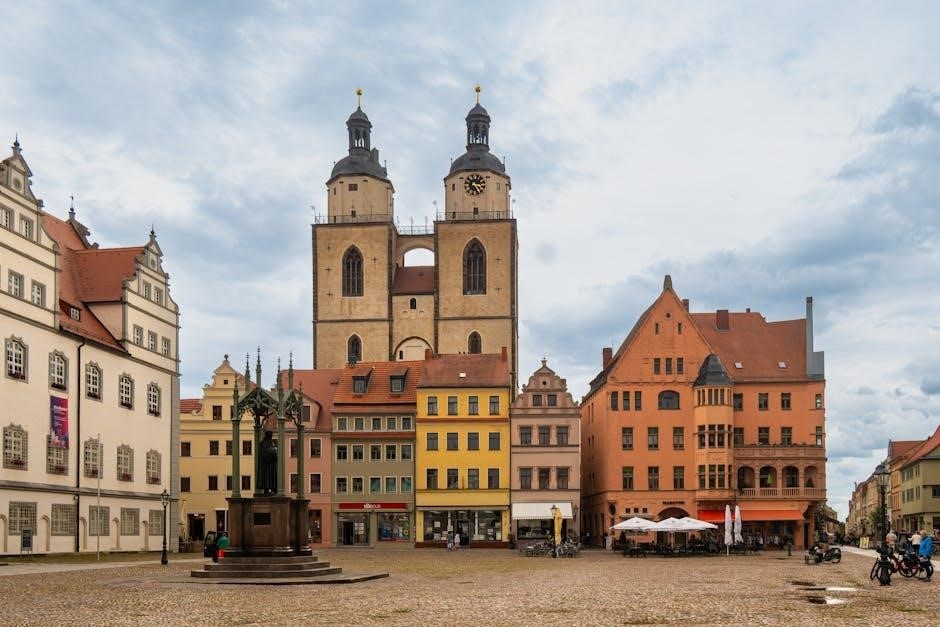
The popular image of Martin Luther dramatically nailing his 95 Theses to the door of the Wittenberg Castle Church on October 31‚ 1517‚ is largely a later embellishment. While Luther did post the theses‚ it was a customary practice for academics to publicly announce debates through postings.
The door served as a bulletin board for university disputations‚ inviting scholars to engage in reasoned discussion. Luther’s intent wasn’t a defiant act of rebellion‚ but rather a call for scholarly debate concerning the practice of indulgences. He addressed the theses to his academic peers‚ specifically Archbishop Albert of Mainz.
Historical evidence suggests the theses were also sent to other theologians. The act of posting was a standard academic procedure‚ and the narrative of a dramatic nailing gained prominence later‚ solidifying Luther’s image as a courageous challenger of authority. The story‚ though partially mythologized‚ powerfully symbolizes the beginning of the Reformation.
Translation into German and Wider Circulation
Initially penned in Latin‚ the language of scholarship‚ Martin Luther’s 95 Theses remained largely confined to academic circles. Recognizing the need for broader engagement‚ Luther swiftly authorized translations into German‚ the vernacular language accessible to the common people. This crucial step dramatically expanded the theses’ reach beyond the university walls.
The German translation‚ coupled with the advent of the printing press‚ facilitated rapid dissemination throughout Germany and beyond. Copies were quickly produced and circulated‚ fueling public discussion and debate about the Church’s practices. This widespread availability ignited popular interest and criticism of indulgences‚ transforming a localized academic dispute into a burgeoning public controversy.
The theses’ accessibility empowered individuals to question established religious authority‚ laying the groundwork for the widespread support Luther would garner in the years to come. The translation proved pivotal in mobilizing public opinion against perceived abuses within the Catholic Church.
Initial Reactions from Church Officials
The immediate response from Church officials to Luther’s 95 Theses was‚ initially‚ one of relative dismissal. Many viewed the document as a localized academic challenge‚ a disputation intended to stimulate debate amongst theologians rather than a direct assault on Church doctrine. Archbishop Albert of Mainz‚ to whom the theses were addressed‚ was primarily concerned with the financial implications of any disruption to the indulgence sales.
However‚ as the theses gained wider circulation – particularly after their translation into German – concern began to grow. Some officials recognized the potential for Luther’s arguments to undermine the Church’s authority and revenue streams. Initial attempts were made to address the situation through dialogue and persuasion‚ hoping to contain the controversy.
These early efforts proved insufficient‚ as Luther steadfastly defended his positions‚ escalating the conflict and ultimately leading to more forceful responses from Rome and the higher echelons of the Church hierarchy.
The Significance of the 95 Theses
Luther’s theses ignited the Protestant Reformation‚ challenging established Church doctrine and sparking religious and political upheaval across Europe with core arguments.
Sparking the Protestant Reformation
The Ninety-Five Theses‚ far from a simple protest‚ acted as a catalyst for widespread religious reformation. Luther’s challenge to indulgences resonated deeply with many who felt alienated by perceived corruption within the Catholic Church. The rapid dissemination of the theses‚ aided by the printing press and translation into German‚ fueled public discourse and debate.
Initially intended for academic discussion‚ the theses quickly transcended their intended audience‚ becoming a rallying point for those seeking religious change. This sparked a wave of theological questioning and ultimately led to the fracturing of Western Christianity. Luther’s questioning of papal authority and emphasis on individual faith laid the groundwork for new Protestant denominations.
The theses’ impact wasn’t immediate‚ but their influence grew exponentially‚ setting in motion events that reshaped the religious and political landscape of Europe for centuries to come. They represent a pivotal moment in history‚ marking the beginning of a new era of religious thought and practice.
Challenging Church Doctrine
Luther’s 95 Theses directly confronted core tenets of Catholic doctrine‚ particularly regarding salvation and the authority of the Pope. He argued against the idea that indulgences could remit punishment for sin‚ asserting that true repentance and faith were the sole paths to forgiveness. This challenged the Church’s established system of penance and its financial practices.
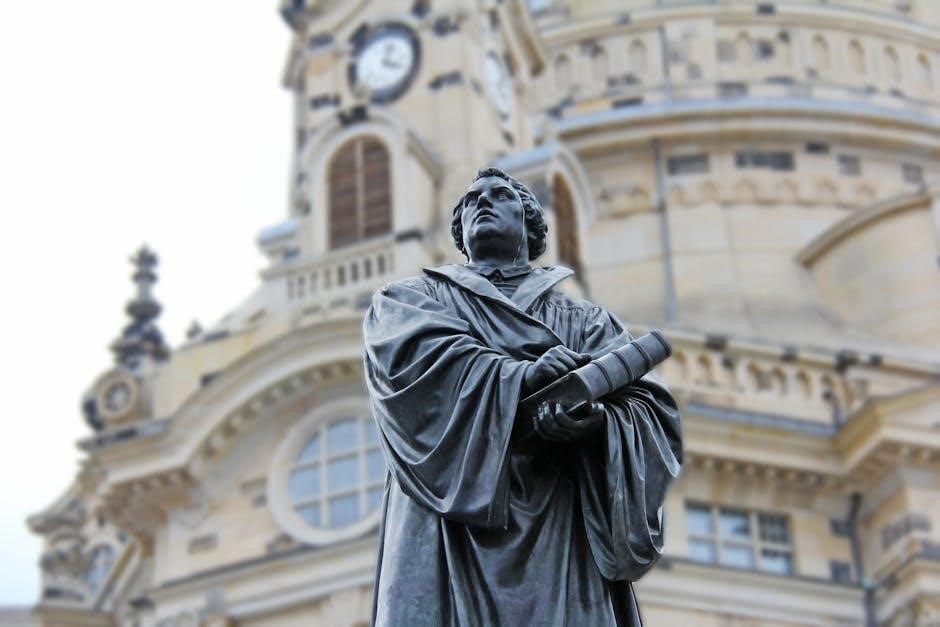
Furthermore‚ Luther questioned the Pope’s power to grant remission of sins‚ claiming such authority rested solely with God. He emphasized the importance of scripture as the ultimate source of religious authority‚ diminishing the role of papal decrees and tradition. This directly undermined the hierarchical structure of the Church and its claim to absolute spiritual power.
By prioritizing individual faith and biblical interpretation‚ Luther’s theses initiated a fundamental shift in theological perspective‚ paving the way for alternative understandings of Christian belief and practice; His challenge wasn’t merely about indulgences‚ but about the very foundations of Church doctrine.
The Debate on Indulgences: Core Arguments
At the heart of Luther’s 95 Theses lay a fierce critique of indulgences – certificates sold by the Church promising remission of temporal punishment for sins. Luther argued these indulgences fostered a false sense of security‚ leading people to believe they could purchase forgiveness rather than seeking genuine repentance. He contended that only God could grant absolution‚ and indulgences misrepresented this divine prerogative.
A central argument was that the Pope possessed no authority over purgatory‚ thus couldn’t remit punishments assigned there. Luther questioned the theological basis for indulgences‚ asserting they undermined the true meaning of penance and contrition. He believed the practice exploited the faithful‚ diverting funds intended for spiritual purposes – like the building of St. Peter’s Basilica – through questionable means.
Luther’s theses weren’t a rejection of all Church practices‚ but a focused challenge to the abuse of indulgences and the misleading theology surrounding them‚ initiating a crucial debate.
Analyzing the 95 Theses Today
Modern scholarship examines Luther’s work as a pivotal historical document‚ readily available in PDF format‚ revealing theological concerns and sparking ongoing academic interpretation.
Availability of the 95 Theses in PDF Format
Digitization has made Martin Luther’s 95 Theses exceptionally accessible to a global audience. Numerous websites offer downloadable PDF versions‚ facilitating study and research for students‚ historians‚ and anyone interested in this foundational document of the Protestant Reformation. These PDFs often include both the original Latin text and English translations‚ catering to diverse linguistic backgrounds.
Furthermore‚ many online resources provide contextual information alongside the theses‚ enhancing understanding of the historical and theological landscape of 16th-century Europe. Searching for “Martin Luther 95 Theses PDF” yields a wealth of options‚ from academic archives to educational platforms. The ease of access allows for detailed analysis of Luther’s arguments against the practice of selling indulgences‚ and the broader critique of papal authority embedded within the document. The widespread availability ensures the continued relevance and study of this landmark text.
Academic Study and Interpretation
Scholarly engagement with Luther’s 95 Theses remains vibrant‚ with ongoing debates surrounding their precise intent and impact. Initially conceived as propositions for academic disputation‚ the theses are now analyzed through lenses of theology‚ history‚ and political science. Researchers examine Luther’s arguments concerning repentance‚ faith‚ and the authority of the Pope‚ tracing their roots in medieval thought and their consequences for the Reformation.
Interpretations vary regarding whether Luther intended to initiate a full-scale break with the Catholic Church or simply to reform practices within it. The PDF format of the theses facilitates close textual analysis‚ allowing scholars to dissect Luther’s Latin phrasing and identify nuances often lost in translation. Contemporary studies also explore the social and economic factors that contributed to the widespread dissemination and reception of the theses‚ solidifying their place as a pivotal moment in Western history.
The Theses as a Historical Document
The 95 Theses represent a crucial primary source for understanding the dawn of the Protestant Reformation. Existing as both original Latin texts and widely available PDF versions‚ they offer direct insight into Luther’s concerns regarding indulgences and perceived theological errors within the Church. Their format – a series of propositions intended for scholarly debate – reveals the academic context of their creation‚ challenging the popular narrative of a defiant act.
Analyzing the document allows historians to reconstruct the intellectual climate of 16th-century Europe‚ examining the prevailing beliefs about salvation‚ penance‚ and papal authority. The theses’ rapid translation and circulation demonstrate the power of the printing press and the growing discontent with Church practices. As a historical artifact‚ the 95 Theses are not merely a list of grievances‚ but a catalyst for profound religious and political change‚ forever altering the course of Western civilization.

Long-Term Consequences
Luther’s challenge ignited religious and political upheaval‚ fostering the rise of Protestant theology and fundamentally reshaping the religious landscape of Europe and beyond.
Religious and Political Upheaval
The dissemination of Luther’s 95 Theses triggered a cascade of religious and political consequences across Europe; Initially intended as an invitation to academic debate‚ the theses rapidly fueled widespread discontent with the Catholic Church’s practices‚ particularly the selling of indulgences. This discontent quickly escalated into open rebellion and the fracturing of Christendom.
The questioning of papal authority‚ central to Luther’s arguments‚ emboldened secular rulers to assert greater control over religious affairs within their territories. This led to conflicts between the Holy Roman Empire and newly Protestant principalities‚ culminating in wars of religion. The Peace of Augsburg in 1555 attempted to resolve these tensions‚ establishing the principle of cuius regio‚ eius religio – “whose realm‚ his religion” – allowing rulers to determine the religion of their states.

Furthermore‚ the Reformation sparked peasant revolts‚ fueled by both religious and socio-economic grievances. While Luther condemned the violence‚ the upheaval demonstrated the potent combination of religious fervor and social unrest unleashed by his initial challenge to the Church.
The Rise of Protestant Theology
Luther’s challenge to indulgences wasn’t merely a critique of a specific practice; it laid the foundation for a new theological framework. Central to this was the doctrine of “sola fide” – salvation by faith alone – rejecting the Catholic Church’s emphasis on good works and sacraments as necessary for salvation. This concept‚ deeply rooted in Luther’s interpretation of scripture‚ became a cornerstone of Protestant thought.
Further theological developments included “sola scriptura‚” asserting the Bible as the ultimate authority‚ and the “priesthood of all believers‚” diminishing the role of the clergy as intermediaries between God and individuals. These principles empowered individuals to interpret scripture directly‚ fostering a more personal relationship with God.
The Reformation’s theological innovations spread rapidly‚ giving rise to various Protestant denominations – Calvinism‚ Anabaptism‚ and Anglicanism – each with its unique interpretations of Luther’s core ideas. This diversification marked a permanent shift in the religious landscape of Europe and beyond.