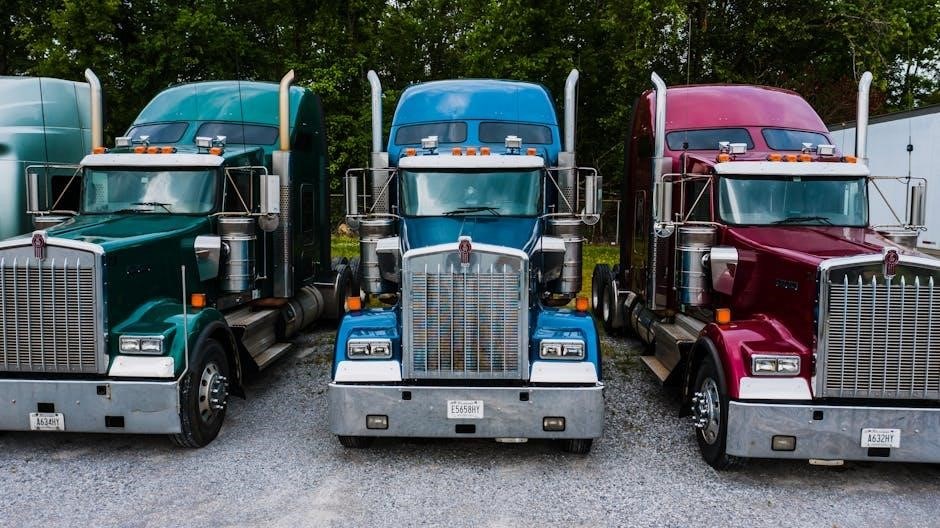
are semi trucks manual or automatic
Are Semi Trucks Manual or Automatic? A Comprehensive Overview (12/19/2025)
Today, December 19th, 2025, semi-truck transmissions encompass manual, automated manual (AMT), and automatic types. While traditionally manual, a notable shift towards automation is currently underway, driven by various factors.
Historical Prevalence of Manual Transmissions
Historically, manual transmissions overwhelmingly dominated the semi-truck landscape. For decades, skilled drivers expertly managed complex gear systems – 8, 9, 10, 13, and even 18-speed configurations were commonplace. These systems demanded significant driver expertise, requiring precise clutch control and gear selection for optimal performance and fuel efficiency.
The prevalence of manual transmissions stemmed from their robustness, relative simplicity, and cost-effectiveness. They offered direct mechanical control, allowing drivers to maximize engine power and tailor gear ratios to varying road conditions and loads. This direct control was considered essential for navigating challenging terrains and ensuring safe operation. The industry standard for many years was a 10-speed manual, though variations existed based on specific trucking needs.
However, the demanding nature of operating these transmissions also presented challenges, including driver fatigue and a steep learning curve for new drivers.
The Shift Towards Automation
Recent years have witnessed a discernible shift away from traditional manual transmissions in semi-trucks, driven by the emergence of Automated Manual Transmissions (AMTs) and fully automatic options. This transition isn’t about completely abandoning manual control, but rather augmenting it with technology to ease driver workload and improve efficiency.
The rise of AMTs represents a crucial stepping stone. These systems automate the clutch and shifting processes while retaining a mechanical linkage, offering some of the benefits of both manual and automatic transmissions. Simultaneously, fully automatic transmissions are gaining traction, providing a more seamless and driver-friendly experience.
This change is fueled by factors like the growing driver shortage, the need for improved fuel economy, and advancements in transmission technology. The industry is actively exploring how automation can address these challenges and enhance overall trucking operations.
Current Market Share: Manual vs. Automatic
As of late 2025, determining precise market share figures is complex, but a clear trend is visible. While manual transmissions historically dominated the semi-truck landscape, their prevalence is decreasing. Many fleets still operate with 10-speed manual transmissions as a standard, though phasing out is underway.
Automated Manual Transmissions (AMTs) currently hold a significant and growing portion of the market, representing a substantial intermediate step. Full automatic transmissions, though still a smaller percentage, are experiencing the most rapid growth in adoption rates.
Estimates suggest AMTs account for a considerable percentage of new truck sales, with automatics steadily increasing. The exact split varies by fleet size and application, but the direction is undeniable: a move towards greater automation in semi-truck drivetrains.

Types of Manual Transmissions in Semi Trucks
Heavy-duty trucks utilize range, splitter, and range-splitter manual transmissions. Common gear configurations include 8, 9, 10, 13, and 18-speed options for varied applications.
Range Transmissions Explained
Range transmissions represent a foundational type of manual gearbox found in many semi-trucks. These systems essentially offer two or more distinct gear ranges – a ‘high’ range for efficient cruising at highway speeds and a ‘low’ range for increased torque when starting heavy loads or navigating challenging terrain.
The driver selects between these ranges using a separate shift lever, typically positioned alongside the main gearshift. Within each range, a standard set of gears provides the necessary speed and torque adjustments. This design simplifies the shifting process compared to more complex transmissions, as the driver doesn’t need to navigate through a vast number of individual gears for every situation.
However, range transmissions generally offer fewer overall gear ratios than splitter or range-splitter designs, potentially limiting the fine-tuning of engine speed to match driving conditions. They remain a viable option, particularly in applications where simplicity and ease of use are prioritized.
Splitter Transmissions Explained
Splitter transmissions offer a unique approach to gearing in semi-trucks. Unlike range transmissions, splitters don’t change the overall range of gears but instead split each gear into two closely spaced ratios. This is achieved through an additional shift lever, often requiring a more complex shifting pattern for the driver to master.
The “splitter” function effectively doubles the number of usable gears, providing finer control over engine RPM and allowing the driver to optimize performance and fuel efficiency. For example, a 10-speed transmission with a splitter becomes functionally a 20-speed. This allows for precise matching of engine speed to load and terrain.
While offering greater control, splitters demand more driver skill and attention. The increased complexity can be fatiguing during long hauls, but the benefits in terms of efficiency and performance are significant for experienced operators.
Range-Splitter Transmissions Explained
Range-splitter transmissions represent the most complex of the traditional manual gearbox designs found in semi-trucks. They combine the functionalities of both range and splitter transmissions, offering the widest array of gear ratios and the greatest degree of control over engine operation.
These transmissions utilize two shift levers – one for selecting the range (high or low) and another for engaging the splitter function, effectively doubling the gears within each range. A typical 10-speed base transmission, when equipped with both range and splitter capabilities, becomes a functionally 20-speed gearbox.
This complexity provides exceptional versatility, allowing drivers to precisely match engine speed to varying loads and road conditions. However, mastering a range-splitter transmission requires significant skill and practice, demanding a high level of driver proficiency.
Common Gear Configurations: 8, 9, 10, 13, and 18-Speed
Historically, semi-trucks have utilized a variety of manual transmission gear configurations, each offering a different balance of versatility and driver complexity. 8-speed and 9-speed transmissions were common in earlier models, providing a relatively simple shifting experience, though with fewer gear options.
The 10-speed manual became a widely adopted standard, offering a good compromise between gear ratios and operational ease. However, more sophisticated options emerged, including 13-speed transmissions, which added an additional splitter or range function for increased flexibility.
The most complex configurations, like 18-speed transmissions (typically range-splitter designs), provided the broadest range of gears, but demanded significant driver skill. Today, while these configurations still exist, their prevalence is decreasing as automated and fully automatic transmissions gain market share.

Automated Manual Transmissions (AMTs)
AMTs bridge the gap between manual and automatic, combining manual gearbox mechanics with automated shifting. They offer drivers enhanced efficiency and reduced fatigue.
How AMTs Bridge the Gap
Automated Manual Transmissions (AMTs) represent a significant evolution in semi-truck technology, skillfully merging the core functionality of traditional manual transmissions with the convenience of automated shifting. Unlike fully automatic transmissions, AMTs don’t utilize a torque converter; instead, they employ computer-controlled actuators to operate the clutch and shift gears. This design retains the mechanical efficiency inherent in manual systems, contributing to improved fuel economy.
Essentially, an AMT automates the actions a driver would typically perform – clutching, shifting, and gear selection – but maintains the direct mechanical link between the engine and the drivetrain. This results in a driving experience that feels familiar to drivers accustomed to manual transmissions, while simultaneously reducing physical strain and potentially enhancing operational efficiency. The semi-automatic gearbox is a variant that combines the advantages of both manual and automatic transmissions.
Benefits of AMTs for Truck Drivers
Automated Manual Transmissions (AMTs) offer substantial benefits for semi-truck drivers, particularly addressing the challenges presented by the ongoing driver shortage. Reduced physical demands are paramount; AMTs eliminate the constant clutching and shifting, minimizing fatigue on long hauls. This leads to increased driver comfort and potentially improved safety, as drivers remain more alert.
Furthermore, AMTs can enhance driver performance by optimizing gear selection for fuel efficiency and smooth operation. While requiring a learning curve, the simplified operation can attract a wider pool of applicants who may be hesitant to learn traditional manual transmissions. The technology also contributes to reduced wear and tear on components, potentially lowering maintenance costs. Ultimately, AMTs aim to make the profession more accessible and sustainable.
AMT Technology and Operation
Automated Manual Transmissions (AMTs) represent a bridge between traditional manual gearboxes and fully automatic systems. They utilize computer-controlled actuators to manage the clutch and gear shifting, mimicking the actions of a skilled driver. However, unlike automatics, AMTs maintain a mechanical connection between the engine and the wheels, offering efficiency benefits.
The system employs sensors to monitor vehicle speed, engine load, and throttle position, determining the optimal gear for any given situation. Drivers typically select a drive mode (e.g., economy, performance) and the AMT handles the rest. While drivers don’t manually shift, they often retain some control, like selecting low gear for steep descents. This blend of automation and driver input provides a unique driving experience, enhancing both efficiency and control.

Automatic Transmissions in Modern Semi Trucks
Full automatic transmissions in semis are gaining traction, offering advantages like simplified operation, but also present drawbacks; adoption is steadily increasing within the trucking industry.
Advantages of Full Automatic Transmissions
Full automatic transmissions present several compelling benefits for modern semi-truck operation. Primarily, they significantly reduce driver fatigue, especially on long hauls, by eliminating the need for constant clutch and gear lever manipulation. This ease of operation is particularly crucial given the ongoing driver shortage within the trucking industry, potentially attracting a wider pool of candidates.
Furthermore, automatic systems often contribute to improved fuel efficiency through optimized gear selection and consistent engine operation. Safety is also enhanced, as drivers can focus more intently on the road and less on the complexities of shifting. While traditionally associated with a perceived loss of control, modern automatic transmissions offer sophisticated control algorithms and features, mitigating this concern. The reduced wear and tear on driver skills also translates to lower training costs for fleet operators.
Disadvantages of Full Automatic Transmissions
Despite their growing popularity, full automatic transmissions in semi-trucks aren’t without drawbacks. Historically, they’ve been perceived as less fuel-efficient than skilled manual drivers, though advancements are narrowing this gap. Initial purchase costs for automatic transmissions are generally higher than their manual counterparts, representing a significant investment for fleet owners.
Some drivers accustomed to manual control may experience a sense of detachment or reduced control, particularly in demanding situations. Repair and maintenance can also be more complex and potentially expensive, requiring specialized technicians and parts. Furthermore, the reliance on electronic systems introduces a potential point of failure, though redundancy measures are increasingly common. Concerns about weight also exist, as automatics can add to the overall vehicle mass, impacting payload capacity.
The Rise of Automatic Adoption
The adoption of automatic transmissions in semi-trucks is demonstrably increasing, fueled by a confluence of industry pressures. A significant driver is the ongoing driver shortage; automatics lower the barrier to entry, requiring less specialized skill and reducing training time. Fleet operators are increasingly recognizing the potential for fuel efficiency gains with modern automatic systems, offsetting initial costs.
Furthermore, safety improvements are a key factor, as automatics reduce driver fatigue and minimize errors associated with manual shifting. The demand for silicon wafers, impacting trucking technology, indirectly supports this shift by enabling more sophisticated electronic control systems. While 10-speed manuals were once standard, they are being phased out, with automatics gaining ground. This trend is expected to continue as technology matures and costs decrease.

Factors Driving the Transition to Automatic
Driver shortages, improved fuel efficiency, and enhanced safety are key catalysts. These factors, alongside advancements in technology, propel the shift towards automatic transmissions.
Driver Shortage and Ease of Operation
A significant driver shortage plagues the trucking industry, creating immense pressure to simplify operation and broaden the potential driver pool. Traditional manual transmissions require substantial skill and training, presenting a barrier to entry for new drivers. Automatic and, increasingly, automated manual transmissions (AMTs) drastically reduce the learning curve.
These systems eliminate the need for constant clutching and gear shifting, making the job less physically demanding and more accessible to a wider range of applicants. This ease of operation is particularly appealing to younger generations accustomed to automatic vehicles. Consequently, fleets are adopting automatic transmissions to attract and retain drivers in a highly competitive market, mitigating the impact of the ongoing driver crisis and ensuring continued freight movement.
Fuel Efficiency Considerations

Fuel efficiency is a paramount concern for trucking companies, directly impacting profitability. Historically, skilled drivers could achieve comparable fuel economy with manual transmissions, optimizing gear selection for specific conditions. However, modern automatic and AMT systems are rapidly closing – and in some cases surpassing – that gap.
These advanced transmissions utilize sophisticated algorithms and sensors to continuously optimize gear selection, maintaining the engine within its most efficient operating range. Furthermore, AMTs and automatics minimize driver error, preventing inefficient shifting habits. While early automatic systems faced fuel economy penalties, advancements in technology have largely overcome these drawbacks, making them a viable, and often superior, option for maximizing miles per gallon and reducing operational costs.
Safety Improvements with Automatic Systems
The adoption of automatic transmissions in semi-trucks correlates with enhanced safety on roadways. Manual transmissions demand significant driver attention, diverting focus from external conditions – a critical factor in accident prevention. Automatic systems reduce cognitive load, allowing drivers to concentrate on steering, monitoring traffic, and responding to hazards.
Eliminating the need for constant clutch operation and gear shifting minimizes driver fatigue, a major contributor to accidents, particularly on long hauls. Moreover, automatic systems often incorporate features like hill start assist and predictive cruise control, further enhancing safety. As the driver shortage persists, utilizing technology to support less experienced drivers and improve overall safety becomes increasingly vital for the trucking industry.

Semi Standards and Transmission Technology
SEMI Standards underpin microelectronics innovation, impacting trucking tech. Increased silicon wafer demand—essential for semiconductors—fuels advancements in automated and automatic transmission systems within semi-trucks.
SEMI Standards in Microelectronics and Trucking Relevance
SEMI (Semiconductor Equipment and Materials International) establishes foundational standards for the microelectronics industry, a sector critically linked to modern semi-truck technology. Over 1,000 industry-approved standards and guidelines, developed by more than 5,000 volunteers, govern the production of semiconductors—the brains behind advanced transmission control systems.
The increasing sophistication of Automated Manual Transmissions (AMTs) and fully automatic transmissions relies heavily on these semiconductors; Demand for silicon wafers, particularly 300mm wafers, directly influences the availability and cost of these crucial components. Recent reports indicate growth in 300mm wafer shipments, alongside a decline in smaller sizes, reflecting the industry’s move towards more advanced technologies.
This connection means fluctuations in the semiconductor market—like inventory adjustments or the impact of AI-driven demand—can ripple through the trucking industry, affecting the pace of transmission technology adoption and innovation. Essentially, advancements in microelectronics, guided by SEMI standards, are enabling the shift towards more efficient and automated semi-truck transmissions.
Impact of Silicon Wafer Demand on Trucking Technology
The surging demand for silicon wafers, particularly driven by Artificial Intelligence (AI) applications, profoundly impacts the evolution of semi-truck transmissions. AI’s role as a transformative force in the semiconductor industry fuels expansion of advanced manufacturing capacity, directly influencing the availability of components for AMTs and automatic gearboxes.
Increased investment across the semiconductor ecosystem, spurred by AI, translates to better transmission control modules and sensors. However, recent data reveals a nuanced picture: while 300mm wafer shipments are growing, demand for smaller 200mm and below wafers is decreasing. This suggests a shift towards more complex, advanced systems.
Inventory adjustments and slowed traditional equipment demand can temporarily constrain supply, potentially impacting the rollout of new transmission technologies in semi-trucks. Ultimately, the health of the silicon wafer market dictates the speed and scope of innovation in automated trucking solutions.

Future Trends in Semi Truck Transmissions
Continued AMT development, coupled with the potential for fully autonomous control and AI-driven optimization, will redefine semi-truck transmissions in the coming years.
Continued Development of AMT Systems
Automated Manual Transmissions (AMTs) represent a crucial bridge between traditional manual gearboxes and fully automatic systems, and their evolution is a key focus for the future. Current development centers on refining shift quality, making gear changes smoother and more predictable for drivers, and enhancing the sophistication of the control algorithms. Manufacturers are striving to minimize the learning curve for drivers transitioning from manual transmissions, ensuring ease of operation and acceptance.
Further advancements involve integrating AMTs with advanced driver-assistance systems (ADAS) and eventually, fully autonomous driving technologies. This includes predictive shifting, where the transmission anticipates terrain changes and adjusts gear selection accordingly, maximizing fuel efficiency. The goal is to create AMTs that offer the fuel economy benefits of a manual transmission with the ease of use and reduced driver fatigue associated with automatics. Expect to see more widespread adoption as these systems mature and become more reliable.
Potential for Fully Autonomous Transmission Control
The ultimate evolution of semi-truck transmissions lies in fully autonomous control, where the system operates independently of driver input, optimizing gear selection based on a multitude of real-time factors. This extends beyond predictive shifting, incorporating data from GPS, road sensors, and even weather forecasts to anticipate driving conditions and proactively adjust the transmission.
Such systems would require incredibly sophisticated algorithms and robust fail-safes to ensure reliability and safety. Integration with vehicle-to-vehicle (V2V) and vehicle-to-infrastructure (V2I) communication could further enhance performance, allowing the transmission to coordinate with other vehicles and traffic management systems. This level of autonomy promises significant gains in fuel efficiency, reduced wear and tear on components, and ultimately, a safer and more efficient transportation network. The development hinges on advancements in AI and machine learning.
The Role of AI in Transmission Optimization
Artificial Intelligence (AI) is rapidly becoming central to optimizing semi-truck transmissions, moving beyond pre-programmed parameters to dynamic, learning-based control. AI algorithms analyze vast datasets – including driver behavior, road conditions, vehicle load, and historical performance – to predict optimal gear shifts and enhance overall efficiency. This goes beyond Automated Manual Transmissions (AMTs) by continuously refining strategies based on real-world outcomes.
AI can also personalize transmission behavior to individual driver styles, maximizing comfort and minimizing fatigue. Furthermore, predictive maintenance capabilities, powered by AI, can anticipate potential transmission issues, reducing downtime and repair costs. As AI technology matures, we can expect even more sophisticated transmission control systems that adapt seamlessly to evolving driving scenarios, contributing to safer and more economical long-haul trucking.